Sunday, September 18, 2011

Homecoming...

An eventful week with a trip to NYC, the dentist, and the final trip to the garden.

9/11 Memorial, NYC                                                               copyright SHD 2011

I was in New York City on Tuesday, Sept 13, 2011, to visit the 9/11 Memorial.  The fountains were open for viewing, the other buildings were not completed. 


Memorial Plaza, NYC                                                             copyright SHD 2011

The Memorial Plaza surrounding the fountains were lined with more than 400 young swamp white oak trees.   The trees were selected and harvested from within a 500-mile radius of the World Trade Center site, with additional trees coming from locations in the Pennsylvania and Washington, D.C., areas that were impacted on September 11, 2001.

The Survivor Tree, Memorial Plaza, NYC
copyright SHD 2011
But the star attaction was the "Survivor Tree."  The callery pear tree became known as the Survivor Tree after sustaining extensive damage, but living through the destruction of the twin towers on September 11, 2001.

I had a little time to stop in Central Park and check out the Conservatory Garden and also visited the Cloisters, where I viewed their medieval herb garden. They had nightshade, mandrake, wormwood, and much more. The place was lovely and I'll talk about that more in a future post.


On Thursday my wallet and I both suffered through a root canal, and on Friday I finished cleaning out the garden, digging up the plants I wanted to keep and take home, including the spilanthes, patchouli, and lamb's ear.


Saturday, September 3, 2011

Best Laid Plans...


...Often go awry....

Okay, so July it was the humidity that damaged the garden.  August had back to back thunderstorms and then hurricane Irene finished the month off with a real big bang....Oh! And then the earthquake for good measure! Jeese, how could I forget that?

Most of the herbs survived fine, but all the other plants were turned to mush.  LOL  Ah, well.  So it goes....

Now, early September, and I must clean out the garden before the 19th.  They are closing early because the park where we are situated will be getting some renovations done during the coming year. 

Some of the things I learned from the garden this season?  Well, I will definitely go with a smaller space next year. This 30'x30' area was fun, but it was too much for one person to handle, even when I was able to get there 3 to 4 times a week. 

What will I do next?  Plan much farther ahead.  I saw what things worked well and what did only so-so.  I will plan next year accordingly.  I am also looking into a different community garden.

I will be digging up a few items to take home, the Lamb's Ear, Stevia, Rue, Spiderwort, Blue Verbena, Patchouli, St. John's Wort, Artichoke (which did well, but never produced a flower), Spilanthes (Tooth-ache Plant, which is doing splendidly and is simply a lovely plant), and not much else.  The Wolf's Bane all died away, sorry to say. 

I was not able to visit any herb gardens or arboretums this summer due to all the extreme weather. I am planning to take some time over the next few months to hit a few places and I will take photos. 

I have one visit already planned, On September 13th, I will be going to  New York City to see the 9/11 Memorial.  I got tickets!  If you are interested in going, the tickets are free and you can get them here.  I will check what they did with the landscaping and make a report. 

I will also be visiting a few other gardens in NYC, one is The Cloisters Museum and Garden at the Metropolitan Museum of Art.  

The Cloisters is a branch of The Metropolitan Museum of Art devoted to the art and architecture of medieval Europe. Just the place for the aspiring herb gardener to check out exactly what types of herbs a witch might have grown way back when.  They also have a terrific Blog called "The Medieval Garden Enclosed."

And of course, Central Park, where I always stop by Strawberry Fields to pay my respects to John.


Also in Central Park is The Arthur Ross Pinetum, a four-acre landscape that features 17 different species of pine trees, as well as an Azalea Pond, Conservatory Garden, the Dene and the Gill, a great Naturalist's Walk, the Olmsted Flower Bed, and the Shakespeare Garden.   

 And last, but not least, there is Steve Brill, the "Wildman of New York." Steve is an environmental educator who gives tours and presentations in Central Park (and elsewhere) that feature a great diversity and abundance of seasonal edible and medicinal wild plants and mushrooms.  Gotta see this guy! Can't wait.


Wednesday, August 3, 2011

Weeds....Ack!

I went to my garden today to continue my war against the weeds. Pulling them out was pretty easy, the ground is soft from the recent rain, phew, it would have been a nightmare otherwise.  I was chased home by more rain, so did not get to finish.  Guess I'm going again tomorrow, but glad of it, as the humidity has gone down considerably. 


Black Swallowtail Butterfly Caterpillar
copyright SHD

While weeding, I discovered something nice.  Among my fennel was the caterpillar of a Black Swallowtail Butterfly.  If you recall my article on Fennel, the Black Swallowtail lives and feeds exclusively on fennel, laying its eggs on the plant, where it's cute yellow, black and green striped caterpillar hatches, grows, pupates, and transforms into a butterfly. 


Monday, August 1, 2011

I hate high humidity

The article reads:  All 50 States See Record Highs in July  "No state in the union was safe from July's blistering heat wave, according to data from the U.S. National Climatic Data Center.  The horrible July heat wave, lasting weeks in some cities, the entire month in others, affected nearly 200 million people in the United States at some point."

That's my official excuse for not getting to the garden for almost three weeks.  I don't feel so guilty any more, it was horrible here in Philly.  The streets were nearly deserted, something I usually only see during a winter blizzard.  That heat and humidity can really sap your energy.

So, now the weeds have taken a strong hold of the garden, although my plants are still doing well, they're beginning to become hidden among the tall grassy weeds.  Heavy sigh.  And its still record hot here, even though the humidity has gone down a little bit.  I have tons of work at the garden that I simply cannot catch up on by going there in the late afternoons. 

Ack.  I hate the humidty even more than I hate winter freezes.


Thursday, July 21, 2011

Hippophae rhamnoides - Sea Buckthorn

Hippophae rhamnoides - Sea Buckthorn also known as Sandthorn, Finbar, Seaberry, Sanddorn and Sallow Thorn.  The common name is from its habit of growing near the sea, and from the many spines or thorns that are reminiscent of some buckthorn species.  Its botanical genus name, Hippophae, literally means, "shiny horse", because the ancient Greeks fed it to their prize racehorses to keep them sleek and healthy.  Sea Buckthorn is not related to Buckthorn, they are two completely different plants.

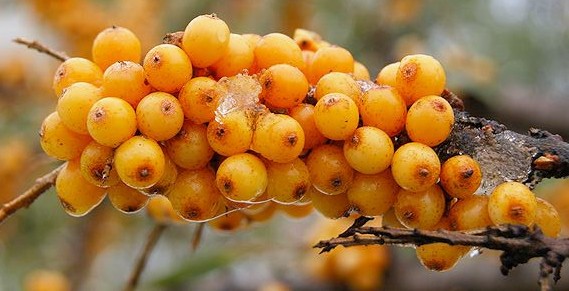
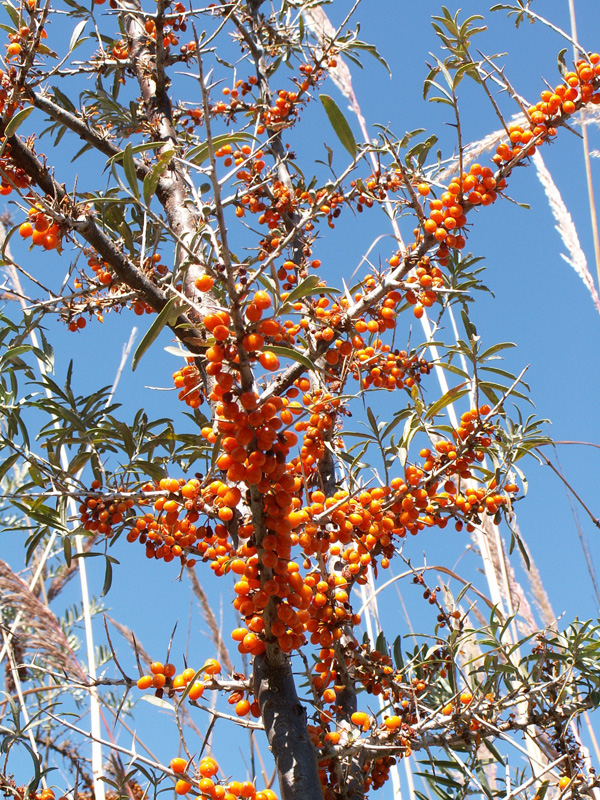
Sea Buckthorn is a small tree with slender, willow-shaped, silvery-green leaves and sharp thorns that grows in Greece and Eastern Europe and eastwards to Russia, Siberia and Central Asia.  Its branches are heavily clustered with soft, juicy bright orange berries that mature in August and September and persist most of the winter.  

The plant is dioecious, with male and female flowers on separate plants. The brownish male flowers produce wind-distributed pollen.  Plants typically grow 6½-13 feet in height, although some in China have reached 59 feet, and others grow no higher than 20 inches.  It is mainly known in North America as an attractive ornamental shrub.

The berries are round to almost egg-shaped, and up to 3/8 inch long. The fruit is usually orange, but yellow and red fruits also occur. Unlike the majority of fruits that fall away from the maternal plant at maturity, the Sea Buckthorn berries remain on the bushes all winter until eaten by birds. The fruits have a distinctive sourish taste and a unique aroma reminiscent of pineapple.

The plant grows naturally in sandy soil at an altitude of 4,000-14,000 feet in cold climates, though it can be cultivated at lower altitudes and into temperate zones. Recently it has been extensively planted across much of northern China, and in other countries, to prevent soil erosion and to serve as an economic resource for food and medicine products.

The Sea Buckthorn berry is featured in the classical medical texts and herbals of Dioscorides and Theophrastus, and even figures prominently in Tibetan Medicine.  Its traditional medicinal use centers on disorders of the skin and digestive tract; it's able to speed the healing and regeneration of the skin and digestive mucosa in inflammatory and ulcerative conditions.  Russian cosmonauts have used its oil for protection against radiation burns in space.  At the Seoul Olympic Games, the official sports drinks of the Chinese athletes were made from Sea Buckthorn berries.

A high-quality medical oil is produced from the fruit of Sea Buckthorn and used in the treatment of cardiac disorders.  Applied topically or externally, it speeds the healing of burns, cuts, ulcers and slow to heal wounds; restores and regenerates the gums in gingivitis; and also heals canker sores.  Internally, it's taken for various digestive complaints, like reflux esophagitis, acid reflux disease, gastric and duodenal ulcers, and ulcerative colitis. 


Biochemically, Sea Buckthorn is so rich in vitamins, minerals and other nutrients that it could be called a vitamin pill in a berry.  In terms of vitamin C and flavonoid content, Sea Buckthorn is second only to Rose Hips and Acerola cherries.  The berries are also incredibly rich in vitamin A, carotenoids, essential fatty acids, vitamin E and other tocopherols.  Phytosterols, along with the above fat soluble nutrients, help lower blood cholesterol, protect the heart, and stimulate the endocrine system.  Other vitamins include B1, B2, K and P.  Sea Buckthorn berries are also rich in minerals, including phosphorus, iron, manganese, boron, calcium and silicon.

Sea Buckthorn berries are an adaptogen, antiinflammatory, antioxidant, antiscorbutic, aperient, astringent tonic, cholagogue, hepatic, immunomodulatory, lipotropic, restorative, virilific and vulnerary.  They help in restoring and improving the eyesight, improving energy, vitality and resistance to stress. 

In respiratory and immune functions it improves resistance to colds and flu; lessens systemic inflammation and ulceration and improves health of the mucous membranes.  It  lowers blood cholesterol and protects the heart, improves digestive health, heals chronic gastric and duodenal ulcers, is a digestive stimulant and gentle aperient laxative in chronic constipation.  It is affective in impotence and premature ejaculation.  It speeds healing of wounds, bruises, ulcers, sores, protects against eczema, psoriasis, skin disorders, beautifies skin, protects against aging, and speeds healing of cuts and burns.

The fresh Sea Buckthorn berries are exceedingly sour and astringent; and so, they are prepared in various ways to make them more palatable.  The berries can be dried and powdered, and either taken by the spoonful and washed down with water, or mixed with honey to make a paste or electuary.  The juice of the fresh berries is usually mixed with sweeter fruit juices to make it more palatable.  The juice is used as a sweetener for herbal teas and makes pleasing sauces, jellies and marmalades.

When the berries are pressed, the resulting sea-buckthorn juice separates into three layers: on top is a thick, orange cream; in the middle, a layer containing Sea-Buckthorn's characteristic high content of saturated and polyunsaturated fats; and the bottom layer is sediment and juice.  Containing fat sources applicable for cosmetic purposes, the upper two layers can be processed for skin creams and liniments, whereas the bottom layer can be used for edible products like syrup.


People were aware of Sea Bucktorn's favorable effect on their health as far back as the Middle Ages when it was used as a blood-staunching healing agent.  In England in the 16th century the plant was used to make jam and also as a remedy against sea-sickness.  The first written documentation of Sea Buckthorn dates as early as the 8th century in a Tibetan book of healing arts called Sibu Yi Dian. Nearly a third of its pages are devoted to the revered holy fruit. 
The Greeks discovered it's healing powers as early as the 12th century when they observed that their sick and aged horses became strong and energetic again after being let loose in areas where the berry grew wild.  Genghis Khan powered his army and their horses on Sea Buckthorn for stamina and recovery from combat.  Legend has it that this berry was the preferred food of Pegasus, the flying horse, by which he became airborne.

Sow seeds in spring in a sunny position in a cold frame.  It usually germinates quickly but 3 months of cold stratification could improve the germination rate.  The seed can also be sown in a cold frame as soon as it is ripe in the autumn. Prick out the seedlings into individual pots when they are large enough to handle and grow on in a greenhouse for their first winter. Plant out in late spring into their permanent positions.


Sea Buckthorn will grow in any soil type so long as they are not too dry, but established plants are very drought resistant.  It requires a sunny position.  Male and female plants must be grown if seed is desired. The sexes of plants cannot be distinguished before flowering, but on flowering plants the buds of male plants in winter are conical and conspicuous while female buds are smaller and rounded.


Resources include: